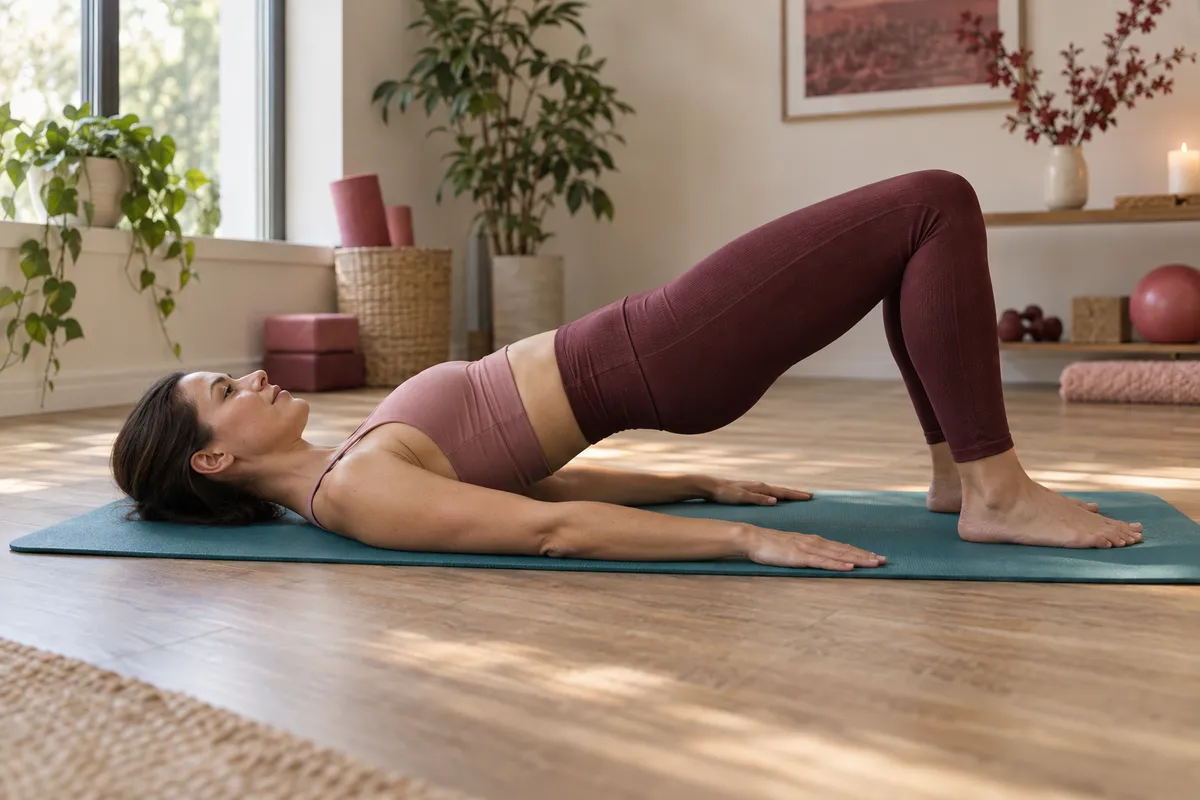
Ask a Pilates instructor to pick a single move to keep for the rest of her life, and you might expect something dramatic. Nicole Hernandez's answer, as reported by Fitandwell, is the pelvic curl. It's quiet, it needs no equipment, and you can do it on a bedroom floor. By the end of this article, you'll know why she picks it, how to try it, and how to adjust it so it suits you.
Why the pelvic curl earns the "forever" label
Per Fitandwell, Hernandez calls the pelvic curl simple but powerful. The reason is that it combines two things many routines treat separately: spinal mobility and strength. In one slow movement, you work your glutes, hamstrings, and core while moving through your spine.
That's the appeal of what's often called a "minimum effective dose" workout: one accessible move that delivers several benefits. If you're building a routine you can keep up at home, a move like this is a sensible anchor.
What it works
Based on Hernandez's description, here is what the pelvic curl asks of your body:
- Spinal mobility: the spine moves one section at a time rather than lifting as a single plank.
- Glutes and hamstrings: they power the lift of your hips.
- Core: it supports and controls the movement, up and down.
How to do a pelvic curl
The source piece focuses on why Hernandez chooses the move rather than a full step-by-step breakdown, so treat the following as a general guide to the classic Pilates version. If you have back pain or an injury, check with a qualified instructor or healthcare professional first.
- Set up. Lie on your back with your knees bent and feet flat on the floor, about hip-width apart. Rest your arms by your sides.
- Find a neutral start. Let your body settle and take a breath in.
- Exhale and curl. Gently tilt your pelvis, then peel your spine off the mat slowly, one section at a time, lifting your hips.
- Pause at the top. Keep your glutes and hamstrings working without forcing your back to arch.
- Roll down with control. Lower your spine back to the mat bone by bone, finishing with your pelvis.
Move slowly. The point is the articulation, not the height of your hips.
What the move should feel like
A good pelvic curl should feel like effort in the backs of your legs and your glutes, with your abdominals supporting the work. If you feel it mostly in your lower back, that's your cue to shorten the lift, slow down, and focus on moving through the spine gradually. Treat this as general coaching guidance rather than something from the Fitandwell piece.
Make it easier or harder
Since the move is foundational, it adapts well. A few simple ways to tune it, offered here as general ideas:
To make it easier
Lift only partway. A smaller range still teaches the sequencing, and you can build height as your control improves.
To make it harder
Slow the tempo, especially on the way down, and add a longer pause at the top. Slower movement asks more of the same muscles without adding equipment.
Where it fits in your week
Because the pelvic curl needs only floor space, it slots easily into low-impact mobility or strength sessions. You could use it as a warm-up before other exercise, or as a short stand-alone practice on days you don't feel like doing much. Even a few slow repetitions is a reasonable start.
Do one slow rep today
Lie down, bend your knees, and curl up one vertebra at a time, then roll back down with the same care. That single, unhurried repetition is the whole idea behind Hernandez's pick: a move simple enough to do for life and rich enough that it never stops being useful.