Pilates has a reputation problem. Many people picture reformer machines, mirrored studios, and a price tag that rivals a gym membership. But the core principles behind Pilates — controlled movement, breath, posture, and stability — don't require any of that. They require you to show up, pay attention to your body, and start somewhere manageable.
For adults over 50, that somewhere is often the wall. Specifically, the wall push-up: a deceptively simple move that delivers real Pilates benefits without getting on the floor, buying equipment, or following along with a video at twice your preferred pace.
By the end of this, you'll understand exactly why this move earns its place in a home routine, how to do it with proper Pilates form, and what to watch out for as a beginner.
Why Pilates Makes So Much Sense After 50
Pilates is low-impact by design. That's not a compromise — it's the point. Where high-intensity workouts load the joints and challenge your recovery, Pilates works with your body's mechanics rather than against them. The focus lands on flexibility, mobility, posture, strength, and core stability: exactly the physical qualities that tend to slip quietly as the decades pass and that make the biggest practical difference in daily life.
Better posture means less back tension when you're sitting at a table or standing in line. Stronger core stability means more confidence on stairs, uneven ground, or any situation that demands balance. Improved mobility means you can reach, bend, and turn without bracing for discomfort.
None of that requires a studio membership or a perfectly flexible body. It requires consistency and movements you can actually do — which is what makes the wall push-up such an honest starting point.
The Wall Push-Up: More Pilates Than You Think
On the surface, a wall push-up looks like a scaled-down version of a floor push-up. In Pilates terms, it's actually a full-body coordination exercise that trains you to stabilize your core while your limbs are working — the foundation of almost everything Pilates asks of you.
Here's how to do it with real Pilates intention:
Set Your Starting Position
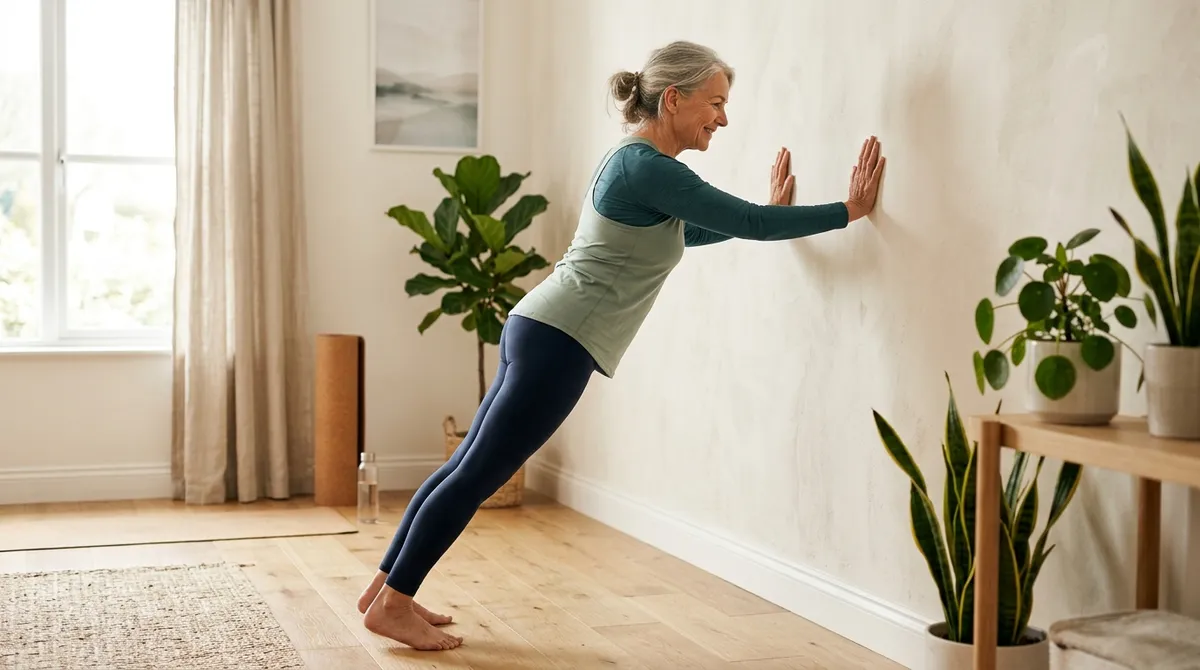
Stand facing a wall with your feet hip-width apart, roughly an arm's length away. Place both palms flat on the wall at shoulder height and shoulder width. Your fingers should point upward, not sideways. Take a moment here — this is already a posture check. Are your shoulders creeping toward your ears? Drop them. Is your chin jutting forward? Bring it back so your neck feels long.
Find Your Pilates Breath
Before you move a single inch, inhale through your nose. As you exhale, draw your lower belly gently inward — not a dramatic suck-in, but a subtle engagement, like you're bracing lightly for a soft punch. This is your core connection. Every Pilates movement begins here.
Execute the Movement
With your core engaged and your body forming one straight diagonal line from heels to crown, bend your elbows and lower your chest toward the wall on an inhale. Your elbows should angle slightly downward rather than flaring straight out to the sides. Keep your hips from sagging or piking — your spine stays neutral throughout.
Pause for one breath at the wall, then exhale as you press evenly through both palms to return to your start position. That's one rep.
Aim for 8 to 10 controlled reps to start. Control beats speed every time here.
What You're Actually Training
When done with this attention, the wall push-up builds shoulder and chest strength, yes — but it also trains core stability under load, reinforces neutral spinal alignment, and develops the mind-body awareness that Pilates runs on. You're learning to coordinate breath with movement, which is a skill that transfers to every other exercise you'll add later.
Common Beginner Mistakes Worth Knowing Now
Holding your breath. It seems minor until you notice how much it tenses your neck and upper traps. Match your breath to the movement intentionally from the first rep.
Letting the hips drift. If your lower back arches or your hips push back as you lower toward the wall, your core has checked out. Reset your belly engagement before continuing.
Moving too fast. Speed removes the work from your stabilizing muscles and puts it on momentum. Slow down until you can feel every phase of the movement distinctly.
Positioning feet too close to the wall. The closer you stand, the easier the move. That's fine when you're brand new, but gradually increase the challenge by stepping back a few inches once the movement feels stable.
Building a Small Daily Habit
Pilates rewards frequency more than marathon sessions. A focused ten minutes most days will do more for your posture and core stability than an occasional hour-long class. Start with the wall push-up as a standalone move — three sets of 8 to 10 reps, with a breath reset between sets. That's less than five minutes.
Pair it with a moment of intentional standing: feet hip-width, weight even, shoulders back and down, chin level. Hold for thirty seconds and notice where your body wants to collapse or compensate. That awareness is already Pilates.
As the movement becomes familiar and your core engagement feels automatic rather than effortful, you'll be ready to add other standing or seated Pilates-inspired moves. But the wall push-up remains useful long after you've advanced — it's an honest check on whether your form fundamentals are still solid.
The Real Payoff
Studio Pilates has genuine value, but it should never be the only path in. The principles that make Pilates effective — controlled breath, intentional alignment, core-first movement — belong to you the moment you understand them. A wall and a few clear minutes are enough to start building the strength, posture, and stability that make everyday life feel more capable.
Start with the wall push-up today. Do it slowly, breathe deliberately, and notice what your body tells you. That's not a warmup for real Pilates — that is real Pilates.